
You tried to bend standard plywood around a curved cabinet frame and it split straight through. That’s not a technique problem. It’s a material problem.
Bendy plywood is a specialty panel engineered specifically for curves. It bends without cracking, holds its shape once installed, and comes in configurations suited to everything from a gently curved kitchen island to a tight-radius column wrap.
Here’s what you need to know: bendy plywood handles structural curves, moisture exposure, and fastener-heavy installations. Bendy MDF is a lower-cost option for purely decorative interior curves. Match the material to your project’s actual demands, and you’ll get the results you need.
Quick Decision Guide
Use bendy plywood for:
- Structural curved cabinet sides
- Moisture-prone areas (kitchens, bathrooms)
- Projects requiring screws or nails near curved edges
- Furniture that carries weight
- Arched doorways and architectural curves
Use bendy MDF for:
- Decorative interior trim only
- Painted finish projects
- Budget-conscious decorative curves
- Controlled interior environments
What Makes Bendy Plywood Different from Regular Plywood?
Standard plywood gets its strength from alternating grain direction between layers. Each layer resists the movement of the one below it. Perfect for flat panels. Terrible for curves.
Bendy plywood is built differently. The core veneers are cut thinner and laminated with the grain running the same direction—called parallel-grain lamination. That construction lets the panel flex along one axis without internal resistance. Instead of fighting the curve, it follows it.
Regular plywood can be coaxed into very gentle bends with enough moisture, heat, and clamping pressure, but it wants to spring back. Tighter curves will split it. Bendy plywood is manufactured to curve. That’s what the product is designed for.
Single-Face vs. Double-Face Bendy Plywood: Which Do You Need?
This distinction matters more than most people realize, and ordering the wrong one adds time and cost to your project.
Single-face bendy plywood flexes in one direction only. The parallel-grain core runs one way, so the panel bends cleanly across that axis. For the vast majority of curved projects—including cabinet faces, column wraps, arched door surrounds, and curved soffits—single-face is all you need. It’s also more affordable than double-face.
Double-face bendy plywood flexes in both directions. The core construction allows bending along two axes, which makes it the right choice for compound curves and complex architectural forms. Think curved reception desks that turn a corner, sculpted furniture pieces, or stage set elements with multi-directional shape. If your surface bends two ways at once, this is what you need.
Forest Plywood carries both. The Bending Italian Poplar is a single-face option with a clean surface that takes veneer or paint well. The Bendy Meranti / Bendy Lauan is another single-face choice widely used in cabinetry and furniture work for its consistent flexibility and stable core.
If your curve only bends one way, single-face gets the job done. Save double-face for projects that genuinely require it.
Bendy Plywood vs. Bendy MDF: Which One Do You Need?
They look similar in the rack and both are made for bending. But they behave very differently once they’re on the job.
| Criteria | Bendy Plywood | Bendy MDF |
| Weight | Lighter | Heavier |
| Finish surface | Veneer-ready, paintable | Smooth, ideal for paint |
| Moisture resistance | Good | Poor, swells with moisture |
| Fastener holding | Strong | Weaker at edges |
| Minimum bend radius | Tighter curves achievable | Wider radius required |
| Structural use | Yes | Limited |
| Best for | Cabinetry, furniture, architectural curves | Decorative interior trim, stage sets |
| Cost | Higher | Lower |
So which one fits your project? Ask yourself these questions before you order.
Is this going anywhere near moisture? Bathroom, kitchen, exterior-adjacent space: go with bendy plywood. Bendy MDF absorbs moisture and swells at the edges. It’s not a question of if, it’s when.
Do you need to fasten near the curved edge? Screws and nails hold reliably in plywood’s laminated core. MDF edges crumble under fastener pressure, especially when the panel is already under tension from bending.
Is this structural or purely decorative? A curved cabinet side carries load. A curved valance above a window does not. Match the material to what your application needs.
Is budget the deciding factor on a simple painted interior curve? If the application is genuinely decorative, interior-only, and paint is the finish, Bendy MDF is a legitimate cost-saving choice. It bends cleanly and paints well. Just know its limits before you commit.
For a deeper look at how standard MDF performs across applications, see our Medium Density Fiberboard guide.
Where Builders Actually Use Bendy Plywood
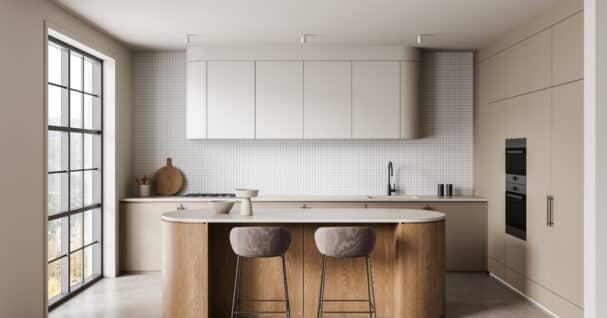
Curved cabinetry and kitchen islands. Wrapping a cabinet face around a radiused corner is one of the most common applications. Bendy plywood follows the curve without the blocking, kerfing, or bending jigs that standard plywood requires. The Bendy Meranti / Bendy Lauan is a go-to for cabinet shops doing this work regularly.
Arched doorways and window surrounds. Following an architectural arch with a clean, unbroken panel face is nearly impossible with standard sheet goods. Bendy plywood conforms to the curve, glues up cleanly against the framing, and leaves a smooth surface ready for paint or veneer.
Curved furniture. Chair backs, upholstered headboards, curved drawer fronts, custom case goods with radiused profiles. Furniture makers reach for bending plywood for curves where steam bending or lamination would be too time-intensive. The Bending Italian Poplar is particularly well suited here, given its clean face and consistent thickness.
Column wraps and feature walls. Retail interiors, hotel lobbies, and restaurant builds use bendy plywood to wrap structural columns and create curved feature wall panels. It goes up quickly, accepts fasteners reliably, and finishes cleanly.
Stage sets and event fabrication. Speed matters in theater and event production. Bendy plywood lets fabricators build curved set pieces without complex forming rigs. Bendy MDF also shows up here when the curve is shallow and the piece will be painted. The lower cost makes sense on applications that won’t see long-term wear.
The Bottom Line
Bendy plywood and bendy MDF are both made for curves, but they serve different jobs. Bendy plywood is the right call when moisture, fasteners, or structural load are part of the equation. Bendy MDF earns its place on decorative interior curves where budget matters and conditions are controlled.
Match the material to the demands of your application, and neither one will let you down.
Forest Plywood has been supplying specialty panels to builders, cabinet shops, and designers for over 50 years. If you’re not sure which product fits your specific curve or radius requirement, we’ll help you spec it correctly before the order ships.
Call us at 800.936.7378 or visit our La Mirada or National City locations.
Frequently Asked Questions
Can you bend regular plywood?
You can force standard plywood into very gentle curves using moisture, heat, and heavy clamping pressure, but it resists the bend and wants to spring back. For anything tighter than a very gradual radius, it will crack or delaminate before it holds the shape. Bendy plywood is manufactured to curve without that resistance. If your project has a defined curve, use the right material from the start.
Is bendy plywood structural?
Yes, within appropriate applications. Bendy plywood carries load along curved cabinet sides, wall panels, and furniture components. It is not a substitute for structural-grade plywood in load-bearing framing assemblies. If you’re unsure whether your specific application qualifies, talk to your supplier before you spec the material.
How do you attach bendy plywood to a curved frame?
Build your curved substrate or bending form first, then glue and clamp the bendy plywood against it. Construction adhesive or PVA wood glue both work well. Fasten with staples or screws through the face into the frame while the adhesive sets. Give it full cure time before releasing the clamps. Once the adhesive has set, the panel holds the curve permanently.
Does bendy plywood come in different thicknesses?
Yes. Common thicknesses are 4mm, 5mm, and 8mm. Thinner panels achieve tighter radii. A 4mm sheet can follow curves that an 8mm sheet cannot handle without stress fractures. Match your thickness to your minimum bend radius requirement before ordering.
How is bendy plywood different from kerfed plywood?
Kerfed plywood is standard plywood with a series of parallel cuts routed into the back face to allow bending. It works, but the kerfs weaken the panel, leave a ribbed back surface, and create potential failure points under sustained stress. Bendy plywood is engineered to flex from the core out. No cuts, no weak points, and a consistent surface on both faces.
What’s the difference between flexiply and bendy plywood?
Flexiply is a trade name used by some manufacturers for flexible plywood panels. The underlying product category is the same. Construction quality, bend radius capability, and face veneer species vary by manufacturer, so don’t rely on the trade name alone. When comparing across suppliers, check the core construction, face species, and minimum bend radius specs to confirm you’re comparing equivalent products.


